By Justin Davis, Drone Camps RC · October 6, 2026
The most important drone news of the week is not about a drone at all. It is about invisible radio pulses, rules written in 2002, and a Federal Communications Commission proposal that could finally legalize the technology behind precision drone landing and GPS-denied navigation. On October 1, 2026, the FCC released a Notice of Proposed Rulemaking to modernize its Part 15, Subpart F ultra-wideband rules — and buried in the notice is language drone pilots have waited decades to see.
The commission expressly seeks comment on permitting UWB-based autonomous drone navigation and landing systems. Read that again: the FCC is asking, on the record, whether ultra-wideband should be allowed to guide drones to their landing pads and through spaces where GPS cannot reach. For anyone who has watched a drone struggle to land precisely or lose its way indoors, this is the starting gun for the technology that fixes both.
Ultra-wideband is a radio technology that trades range for extraordinary precision. By transmitting extremely short pulses across a wide swath of spectrum, UWB systems can measure distance and direction to within centimeters — far tighter than GPS, Bluetooth, or Wi-Fi positioning. It operates on unlicensed spectrum, which means no expensive licenses and no carrier middlemen.
The catch has always been the rules. The FCC's UWB framework dates to 2002, when the technology was a laboratory curiosity and drones were military hardware. The rules were written for a world that no longer exists, and they have been strangling UWB innovation ever since.
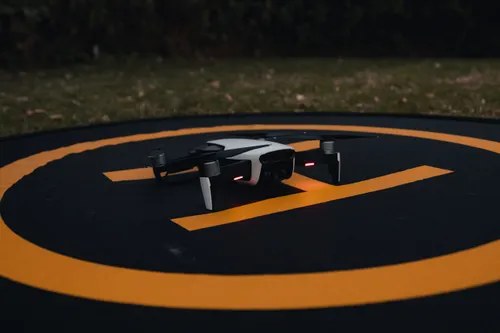
Ask FPV and enterprise pilots what they want most, and two answers dominate: the ability to land exactly where intended, every time, and the ability to navigate where GPS does not work — indoors, under bridges, between buildings, inside warehouses. UWB solves both. A landing pad with UWB beacons can guide a drone to a centimeter-precise touchdown. A room fitted with UWB anchors gives a drone indoor positioning that GPS could never provide.
Today, builders who want these capabilities mostly work around the rules or operate in legal gray areas. A modernized framework that expressly permits UWB-based drone navigation and landing would move the technology from the shadows into the mainstream — and unlock a wave of products built around it.
It is worth remembering how we got here. When the FCC wrote the UWB rules in 2002, consumer drones did not exist, the iPhone was five years away, and ultra-wideband was a research project with no commercial market. Regulators wrote conservative rules for a technology they barely understood, then left them frozen for nearly a quarter century while the world changed around them. This rulemaking is, in a real sense, the FCC admitting the obvious: the 2002 framework was built for a different century.
The proposal goes further than navigation. The FCC is also asking whether to revisit the long-standing prohibition on UWB operation aboard aircraft — a ban that dates to an era when regulators feared any new radio emission near avionics. The notice even raises the question of UWB in toys, a category the 2002 rules walled off entirely.
Revisiting the aircraft ban matters because the most capable drone applications are, by definition, aboard aircraft. A rule that permits UWB everywhere except on the vehicles that need it most was never going to survive contact with the drone age. The FCC appears to know it.
Perhaps the most telling detail: the FCC granted two rulemaking petitions — one filed in 2019, another in 2025 — and opened a comprehensive review of the entire UWB framework. For two decades, companies seeking to deploy UWB in new ways have survived on individual waivers, each one a bespoke negotiation with the commission. The notice describes, in effect, the end of that era.
"Regulation by waiver" is how industries limp along when the rules cannot keep up. It favors incumbents with lawyers and punishes startups with ideas. A modernized, comprehensive UWB framework replaces case-by-case permission with clear rules — exactly the shift the drone industry needs.
Consider what becomes possible once the rules catch up. Delivery drones that settle onto a porch pad the size of a dinner plate. Warehouse inventory drones that navigate aisles for hours without a single GPS satellite. FPV pilots with a "return to pad" failsafe that lands within inches instead of somewhere in the general vicinity. None of this requires new physics — the hardware exists today. It has been waiting on permission.
Timing is everything. As the FCC simultaneously tightens restrictions on foreign drone components, American manufacturers are hunting for differentiating technology they can build domestically. Precision navigation and landing — powered by UWB, built on unlicensed spectrum, with no foreign supply chain required — is exactly the kind of capability that could define the next generation of US-built drones.
The rulemaking is just beginning; a Notice of Proposed Rulemaking is an invitation to comment, not a final rule. But the direction is unmistakable. After twenty-four years, the FCC is finally asking the right questions about ultra-wideband. The answers could reshape how drones find their way home.