By Justin Davis, Drone Camps RC · October 6, 2026
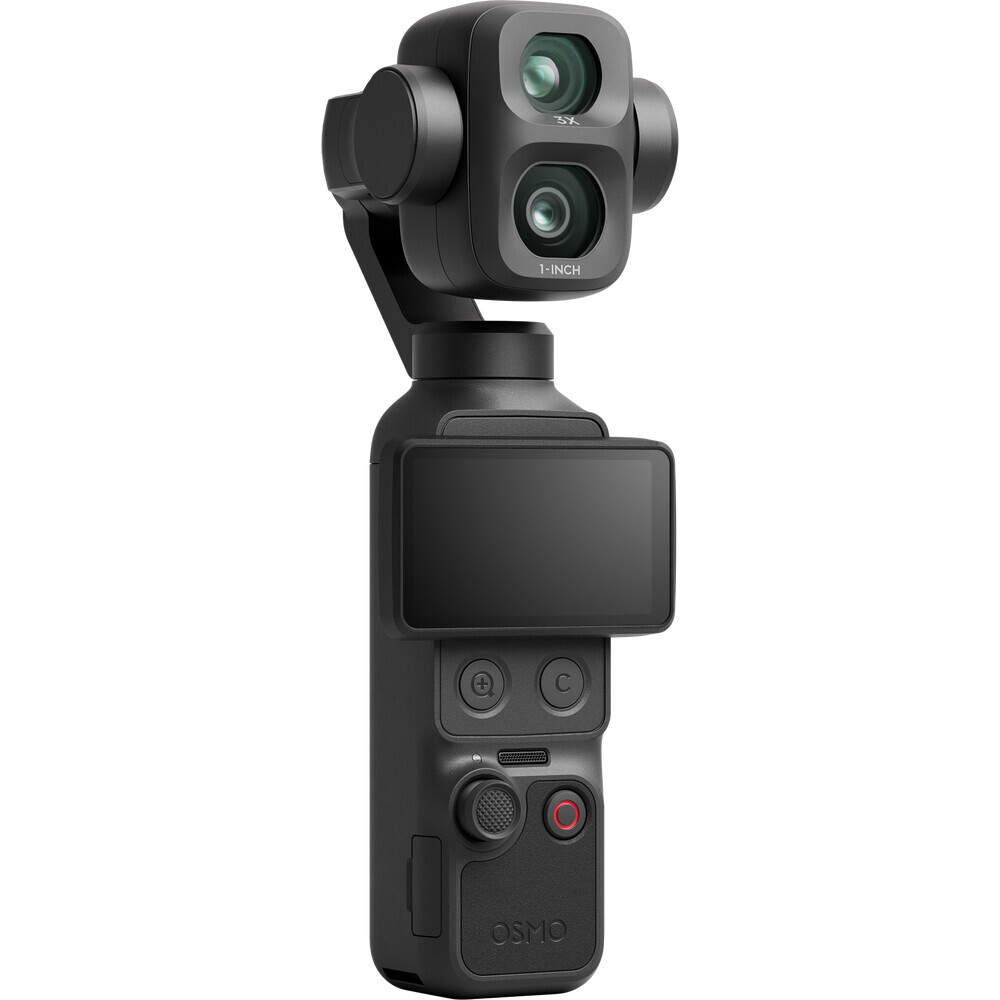
DJI's most interesting new product this month is not a drone at all — and it has Huawei's name on the box. At Huawei's Mate90 launch event around October 1, the two Chinese tech giants unveiled a co-branded version of DJI's Osmo Pocket 4, the pocket gimbal camera that has become the default vlogging tool for an entire generation of creators. The hardware will look familiar. The software story is entirely new.
On the spec sheet, the co-branded Pocket 4 is the standard Pocket 4: a 1-inch CMOS sensor behind an f/2.0 lens, 4K slow-motion at a blistering 240 frames per second, 10-bit D-Log color for serious grading work, and 107 GB of onboard storage. That is already a formidable little camera — the 1-inch sensor is the same class of imaging hardware that made the Pocket line a legitimate alternative to carrying a mirrorless camera. What Huawei brings to the partnership is not glass or silicon. It is the connective tissue between the camera and the phone in your pocket.
The centerpiece of the collaboration is HiShare integration, Huawei's high-speed device-to-device transfer protocol, baked directly into the camera. Photos and video shot on the Pocket 4 can be beamed straight to a Huawei phone with a tap — no cables, no card readers, no waiting for a slow wireless transfer to finish while your shooting momentum dies. For creators who shoot and post from the field, that friction has always been the worst part of using a dedicated camera instead of just shooting on the phone.
The integration runs deep into both companies' software stacks. Support requires HarmonyOS 7.0.0.107 SP6 on the phone side, DJI Mimo app version 1.7.0, and camera firmware V01.04.12.14 — a coordinated rollout scheduled for mid-October 2026 that tells you how tightly the two engineering teams had to work together. This is not a sticker-slap partnership; it is a genuine joint software effort.
When wireless will not cut it — say, offloading a full day of 4K/240fps slow-motion, which devours storage at a terrifying rate — the co-branded Pocket 4 supports wired export at up to 800 MB/s over USB 3.1. That is properly fast: a full 107 GB of footage could theoretically move in a couple of minutes rather than the better part of an hour. For wedding videographers, travel creators, and anyone else who has ever watched a progress bar crawl at 2 a.m. in a hotel room, this is a quality-of-life upgrade that matters more than any spec-sheet bullet about dynamic range.
Perhaps the cleverest trick in the partnership: the Pocket 4 can serve as a second camera angle inside a Huawei phone's livestream. Start a stream on the Mate90, and the gimbal camera joins as an additional feed — giving solo creators a two-camera setup without a second operator, a switcher, or any of the traditional multicam hassle. One device stays locked on the wide shot while the Pocket 4 roams for close-ups, all stabilized on its 3-axis gimbal.
The Creator Combo microphones get the same treatment, pairing directly to the phone with support for up to two transmitters. The whole pitch is a complete mobile production kit — camera, audio, streaming — where every piece talks to every other piece with minimal setup. It is the kind of ecosystem thinking Apple has applied to its products for years, now aimed squarely at the creator market.
The final piece is the quietest and possibly the most consequential for how people actually use the camera: when the Pocket 4 is charging on Wi-Fi, it automatically uploads new footage to Huawei Cloud. No manual backup step, no forgotten cards, no lost footage from a camera left in a taxi. It is the same "it just handles it" philosophy that made smartphone photo libraries feel effortless, extended to a dedicated camera for the first time in a way that actually works.
Step back from the feature list and the strategic picture comes into focus. DJI's drone business in the United States remains constrained by the authorization regime that has choked new product launches — a situation this site has covered extensively. But DJI the company is much bigger than DJI the drone maker, and partnerships like this one show where the growth energy is going: deeper into the creator ecosystem, with phone makers as distribution and integration partners rather than competitors.
Huawei, for its part, gets a halo imaging product that makes its phones more attractive to exactly the creator demographic both companies covet. Co-branding deals like this used to be the province of camera companies and phone makers — Leica and Xiaomi, Hasselblad and Oppo. DJI muscling into that club, as an equal partner rather than a component supplier, says a great deal about how far the company's imaging credibility has come. The drone pilots among us might feel a pang that the innovation spotlight has shifted, but there is a silver lining: a DJI that thrives on cameras, mics, and gimbals is a DJI that survives to keep making drones too.