By Justin Davis, Drone Camps RC · October 6, 2026
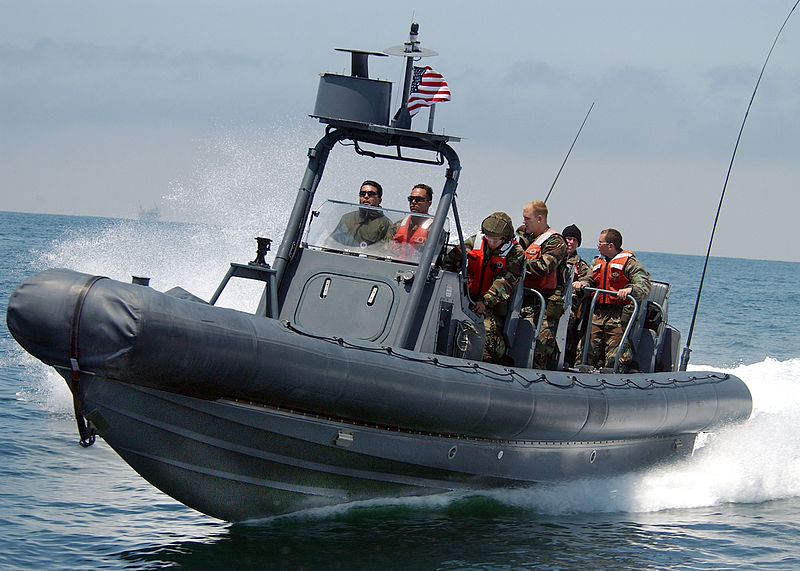
On September 18, 2026, off the coast of Okinawa, a U.S. Marine unit did something that would have sounded like science fiction a decade ago: they launched an FPV attack drone — a Neros Archer — from the deck of a small, moving reconnaissance craft, and flew it as a proof of concept for maritime drone operations. The test was documented by the Defense Visual Information Distribution Service, the military's public imagery arm, which is how we know it happened at all.
For the FPV hobby community, this is worth paying attention to. Not because anyone at Drone Camps is building attack drones — we are not, and the site's purchase terms prohibit military use of anything sold here — but because the world's most demanding drone customer just validated, again, that small FPV aircraft are now a core military capability. When Marines are launching them off boats, the technology has fully crossed from hobby curiosity to institutional doctrine.
The details made public are deliberately limited, as you would expect. What is confirmed: Marines embarked on a small reconnaissance craft launched a Neros Archer — a first-person-view drone configured for attack missions — while the boat was underway off Okinawa. The flight was described as a proof of concept, meaning the point was to demonstrate that the concept works, not to conduct an operational mission.
Launching from a maneuvering boat is meaningfully harder than launching from shore. The deck is moving in three axes, wind over the deck changes constantly, and the pilot must account for the platform's motion during the most critical seconds of flight. Getting an FPV drone airborne cleanly under those conditions — and recovering the lessons for the next attempt — is exactly what proof-of-concept testing is for.
Until now, small military drones have mostly launched from fixed positions: shore sites, forward bases, rooftops. Fixed launch points are predictable. An adversary that knows where your drones come from can watch those locations, jam them, or strike them.
A small boat changes that calculus entirely. A reconnaissance craft can reposition constantly, launch from anywhere along a coastline, and disappear back into maritime traffic. For a force operating across island chains — which is precisely the geography around Okinawa — boat-launched drones turn every stretch of water into a potential launch zone. The launch point becomes as mobile as the mission requires.
This is the same logic that made aircraft carriers revolutionary a century ago, miniaturized to the extreme: take the airfield with you. Except now the "aircraft" costs a fraction of a traditional military drone and the "airfield" is a small boat with a deck.
Okinawa sits at the center of what strategists call the First Island Chain — the arc of islands running from Japan through Taiwan to the Philippines. U.S. Marine units in the region have been reorganizing around the idea of operating in small, dispersed teams across these islands rather than concentrating in large, vulnerable bases.
Small drones fit that doctrine perfectly. They are cheap enough to distribute widely, capable enough to matter for both reconnaissance and strike missions, and — as this test demonstrates — launchable from the same small craft the dispersed forces already use to move between islands. The stated aim is less predictable launch points across the island chain: recon or strike capability that an adversary cannot easily map or preempt.
None of this is happening in a vacuum. The lessons of recent conflicts, where FPV drones have proven devastatingly effective, are being absorbed by every major military. The Okinawa test is the U.S. Marine Corps writing those lessons into its own playbook.
Here is the part that matters to pilots reading this site. Every time a military validates FPV technology, three things happen that benefit the hobby. First, investment floods into the underlying tech — better motors, better video links, better flight controllers — and economies of scale push prices down for everyone. Second, the talent pipeline grows: the skills you build flying a whoop around your house translate directly to the skills militaries now pay to teach. Third, public legitimacy increases, which helps when regulators weigh the future of the hobby.
There is a flip side, of course. Military adoption also drives counter-drone development and can complicate the regulatory environment. But on balance, the mainstreaming of FPV is the single biggest tailwind the hobby has. A decade ago we were strapping analog cameras to toys; today Marines launch FPV aircraft off boats in the Pacific. The trajectory is unmistakable.
The Okinawa test was small — one drone, one boat, one proof of concept. But proofs of concept are how doctrines are born. Somewhere in the Marine Corps, planners are now working out what a boat-launched FPV capability looks like at scale: how many drones per craft, what the command structure looks like, how it integrates with everything else afloat. And every answer they develop will rest on the same foundation the hobby built — small, agile, first-person-view flight. The skills you practice on weekends are, quite literally, the future of military aviation's smallest aircraft.