By Justin Davis, Drone Camps RC · October 6, 2026
By the end of this year, Amazon's Prime Air could be delivering by drone in nearly 500 cities and towns across America. If that number holds, it won't just be the biggest drone delivery operation in the country — it will be the operation that sets the standards every other delivery drone has to live with.
That's worth understanding, whether you're excited about the future or dreading the sound of it. Because when one company operates at that scale, its choices about altitude, noise, and safety become the de facto rules of the sky over suburbia.
Start with the credential that makes all of this possible. Amazon holds an FAA Part 135 Air Carrier Certificate, issued in 2020 — the same category of operating authority as commercial airlines. Only seven operators nationwide hold Part 135 authority for drone delivery. Seven. In the entire country.
That exclusivity is the moat. Part 135 isn't a waiver or a permission slip; it's a full air-carrier certification with the operational rigor that implies — maintenance programs, crew training standards, safety management systems. Amazon spent years earning it, and it shows in how the company talks about its operation: not as a tech demo, but as an airline that happens to fly robots.
For the hobby world, the Part 135 club is a useful reality check. The regulatory bar for routine commercial drone delivery is extraordinarily high — which is both reassuring (these operations are genuinely scrutinized) and sobering (the gap between what Amazon can legally do and what you can do with a Mavic is enormous, and it's not closing anytime soon).
The current footprint covers Dallas-Fort Worth, Houston, Phoenix, Detroit, and Tampa — Sun Belt suburbs, mostly, where the weather cooperates and the rooftops sprawl. The plan from here is aggressive: suburban communities in nearly 500 cities and towns by the end of 2026.
Think about what that buildout requires. Each location needs a launch facility, FAA coordination, local political groundwork (as North Haven and North Myrtle Beach are demonstrating), and enough order density to justify the operation. Five hundred cities isn't a pilot program. It's a national logistics network with rotors.
The suburban focus is deliberate. Dense cities bring airspace complexity, tall buildings, and political headaches. Suburbs offer the sweet spot: enough customers, manageable airspace, and local governments that can be won over one by one. If you live in suburbia, the odds are increasingly good that your sky is on the list.
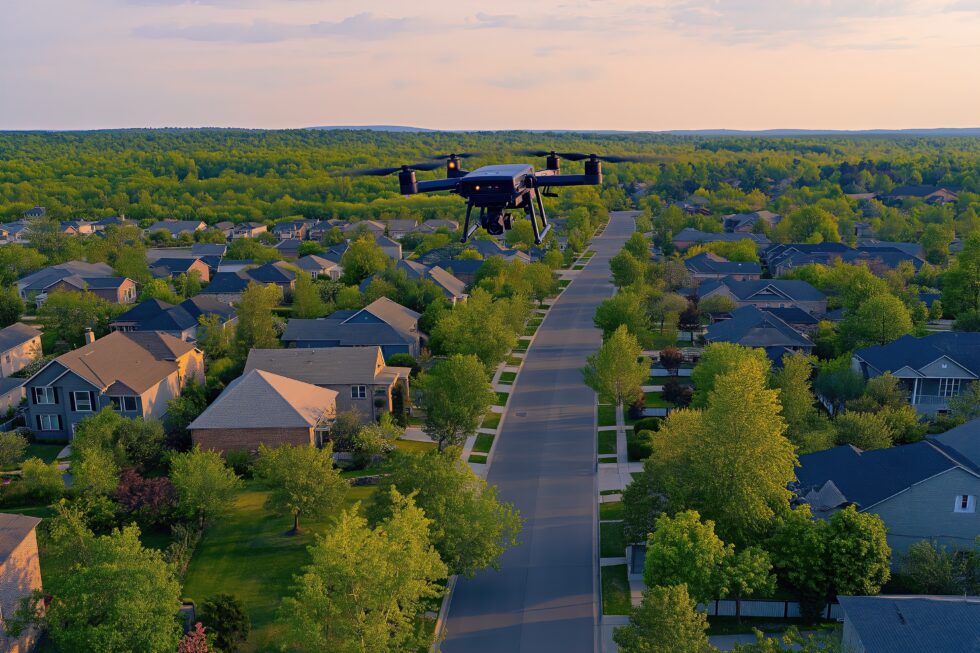
The aircraft carrying this expansion is the MK30: five-pound packages, a 7.5-mile range, a 400-foot maximum altitude, and a marketed promise of 30 minutes from order to door. Those specs describe a very specific mission — the last-mile sprint, not the long haul.
Five pounds covers a remarkable slice of e-commerce: medications, small electronics, household essentials, a few grocery items. The 7.5-mile range defines the service area around each hub. And 400 feet keeps the aircraft well below manned traffic while staying high enough to transit between neighborhoods without threading every backyard.
The 30-minute promise is the one that changes behavior. When delivery drops from "tomorrow" to "half an hour," people start ordering differently — the forgotten ingredient, the urgent prescription, the thing you need right now. Amazon isn't just selling speed. It's training customers to expect it, which is how a novelty becomes infrastructure.
Here's the most interesting part of the MK30 story: it replaced earlier models specifically to extend range and quiet rotor noise after neighborhood complaints. Amazon learned the hard way that the technology wasn't the hard part — the neighbors were.
Drone noise is a peculiar problem. It's not just loudness; it's character. The high-pitched whine of small rotors cuts through background noise in a way that people find uniquely irritating, even at low volumes. Early Prime Air operations generated exactly the complaints you'd expect, and Amazon's response — redesigning the aircraft for quieter operation — is an admission that social license matters as much as regulatory license.
This is the standard-setting dynamic in action. Whatever noise level Amazon achieves at 500 cities becomes the benchmark. Regulators will point to it. Competitors will have to match it. Residents will expect it. The MK30's rotors are, in a very real sense, writing the noise rules for the entire industry.
Step back and the picture is stark: one company, rare federal authority, 500 cities, an aircraft redesigned around neighbor complaints, and a 30-minute promise rewiring consumer expectations. Whether Prime Air succeeds or stumbles, its choices will shape the operating environment for every delivery drone that follows — the altitudes considered normal, the noise considered acceptable, the safety record considered adequate.
For drone pilots watching from the hobby side, there's a strange symmetry. We spent years arguing that drones are safe, useful, and here to stay. Amazon is about to prove it at a scale none of us imagined — and in doing so, it will define what "safe and useful" officially means. Pay attention to the standards being set. We'll all be living under them.