By Justin Davis, Drone Camps RC · October 6, 2026
Cold ice cream, delivered by drone, in under nine minutes. It sounds like a marketing stunt, but in Lewisville, Texas, it's just September. Tongue in Cheek Ice Cream began testing Zipline delivery on September 25, 2026, and by September 30, about 20 orders had already flown. Owner Brett Smith says customers "are loving it" so far. Honestly? It's easy to see why.
Forget the grand visions of drone delivery revolutionizing logistics. Sometimes the future arrives as a pint of ice cream that didn't melt on the way over. This is the story the industry should be telling — not the 500-city master plans, but the thing that actually worked, for real people, last week.
The headline number is the delivery time: under nine minutes from order to arrival. That's not a projection or a lab result. That's the measured experience of the first 20 customers, in a real suburb, with real traffic and real weather.
Nine minutes reframes what delivery means. At that speed, you're not planning dinner — you're satisfying a craving. The use case isn't "I need groceries" but "I want ice cream now." It turns out "now" is a powerful product category, and drones are genuinely good at it in a way that cars in suburban traffic simply aren't.
Smith's read on the early results is telling. Twenty orders in five days isn't a flood — it's a careful trial. But "customers are loving it" is exactly what you want to hear at this stage. No complaints about noise, no melted pints, no drama. Just ice cream, fast.
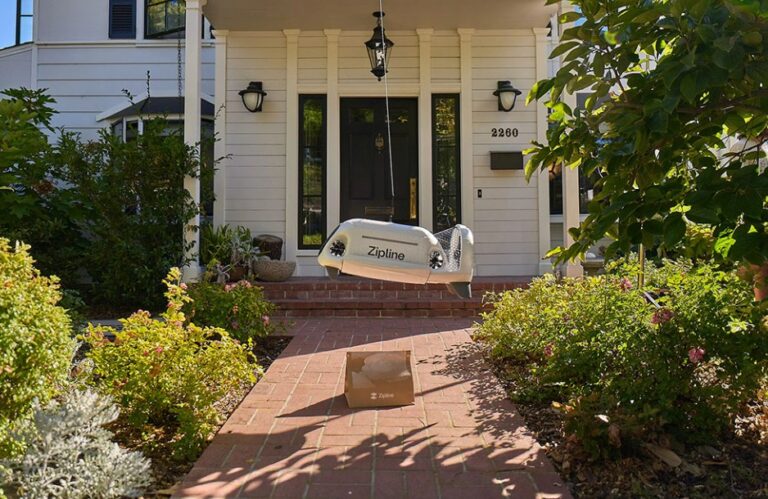
Zipline's system takes a fundamentally different approach than the competition. The aircraft stays overhead — typically above 300 feet, where Smith notes it's barely audible — while an insulated pod descends on a tether to place the order precisely where it needs to go.
That design choice solves several problems at once. Altitude means noise dissipates before it reaches the ground. The tether means the aircraft never has to descend into the obstacle-rich zone of trees, power lines, and curious onlookers. And the insulated pod means the cargo — in this case, the meltable kind — arrives in the condition it left in.
Compare that to aircraft that descend to rooftop height for every delivery. Every low-altitude descent is a noise event, a safety exposure, and a chance for something to go wrong near people and property. Zipline's bet is that the sky is for flying and the ground is for receiving, and the tether is the bridge between them. The ice cream results suggest the bet is paying off.
The shop plans to expand the trial to its Richardson location once the service is available there. Which brings an interesting wrinkle: Richardson is also home to Amazon's new delivery launchpad. Two radically different drone delivery philosophies, operating in the same Texas suburbs, at the same time.
Smith's take is diplomatic but pointed: the Zipline partnership is less disruptive. That's a shop owner choosing, in public, between two suitors — and picking the quiet one. When the businesses on the ground start expressing preferences about whose drones fly over their customers, the industry should listen.
The Richardson overlap sets up a natural experiment. Same suburbs, same customers, two approaches: high-altitude tether drops versus low-altitude direct delivery. Whichever one neighbors tolerate better will tell us more about the future of drone delivery than any corporate roadmap.
This is the real story inside the ice cream story. Zipline's aircraft at 300-plus feet is "barely audible." Amazon's MK30 descends to about 13 feet over lawns. One philosophy minimizes the drone's presence; the other accepts it as the price of the delivery.
Neither approach is obviously wrong. Direct low-altitude delivery can handle heavier packages and trickier drop zones. High-altitude tether systems trade some flexibility for neighborliness. But as these operations scale from trials to hundreds of cities, the tolerance question gets louder — literally. The company whose drones people barely notice has a structural advantage in every zoning fight, every comment period, every town hall.
For FPV pilots, there's a familiar lesson here. We learned long ago that the difference between a welcome flying spot and a banned one is often just noise and consideration. The commercial world is learning the same lesson, one suburb at a time.
The drone industry loves big visions: revolutionized logistics, transformed supply chains, the sky full of commerce. Lewisville offers something better than a vision — a proof point. Twenty orders. Nine minutes. Cold ice cream. Happy customers. A shop owner who wants more.
That's how technologies actually win: not with the grand announcement, but with the small thing that works so well people stop thinking of it as technology at all. Nobody in Lewisville is marveling at the future. They're just getting ice cream, fast, from the sky. And honestly? That's the most futuristic thing of all.